
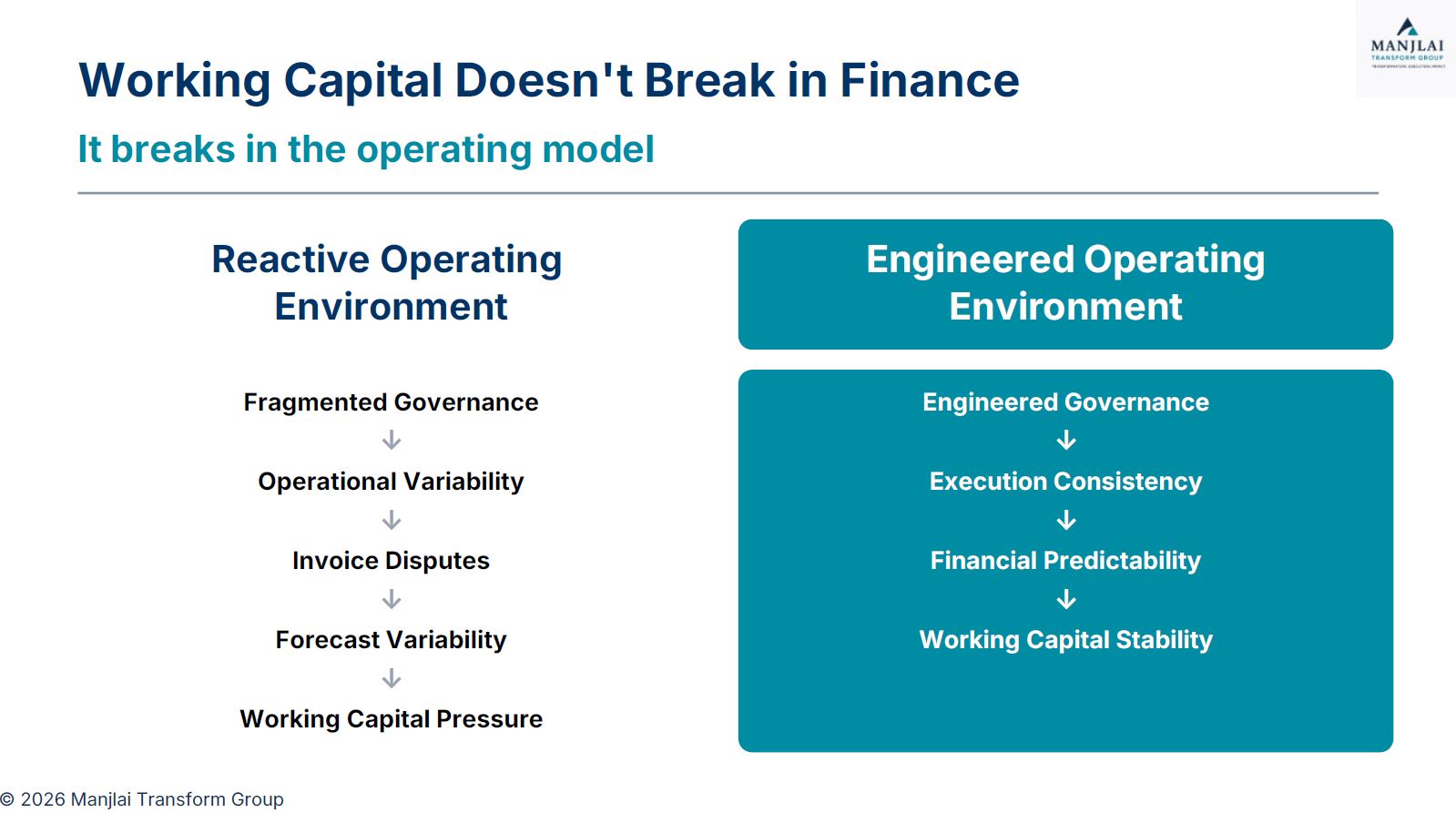
Cash flow doesn’t break in finance. It breaks in the operating model.
When working capital tightens, organizations respond predictably and they:
Extend payment terms.
Freeze discretionary spend.
Push suppliers for concessions.
Tighten approvals.
These actions may create temporary relief, but rarely reduce operational variability creating the pressure in the first place. Because working capital volatility is rarely a treasury problem. It is a governance signal. More often than not, this signal points upstream to how suppliers are structured,measured, and managed.
Why Working Capital Is Misdiagnosed
Most companies treat working capital as a:
• Finance KPI
• Quarterly pressure valve
• Negotiation target
Volatility does not originate in reporting. It originates in fragmentation:
• Inconsistent demand signals
• Contract leakage
• Disputed invoices
• Variable supplier performance
• Escalation driven decision making
Finance experiences the outcome. Governance determines the cause.
Until this distinction is understood, organizations continue to treat financial symptoms while reproducing the operating conditions to create them.
Payment Terms Are Governance Signals
Payment terms are not administrative settings. They are governance signals, and reveal whether an organization manages suppliers transactionally or architecturally.
In mature environments:
• Terms are intentional and consistent
• Risk allocation is explicit
• Performance expectations are enforced
• Renegotiation happens within structure not crisis
In fragmented environments:
• Terms vary without rationale
• Exceptions accumulate
• Disputes increase
• Forecasts swing
The difference is not negotiation skill. It is governance discipline.
Payment terms are not administrative mechanics. They are behavioral architecture embedded into the operating model.
Contract Adherence and Revenue Recognition
Weak governance rarely announces itself loudly.
It shows up quietly:
• Contracts erode over time
• Invoices deviate from agreed terms
• Disputes delay payment
• Manual interventions multiply
These frictions don’t just slow cash.
They distort financial clarity:
• Accruals expand
• Adjustments increase
• Forecast accuracy declines
Individually, these frictions appear manageable. Collectively,they erode financial predictability across the enterprise.
Strong governance reduces friction before finance has to correct it.
Clear standards.
Transparent performance data.
Consistent enforcement.
Cash improves not because finance tightens control but because fewer exceptions require control in the first place.
Governance as a Cash Accelerator
Organizations often ask how to “unlock” working capital.
The better question is: What in the operating model creates variability?
When supplier governance is engineered:
• Performance variability declines
• Dispute cycles shorten
• Allocation aligns with delivery
• Escalations reduce
• Accountability becomes visible
When governance absorbs variability, cash flow becomes predictable. This is the shift. Cash flow stabilizes not because pressure increases, but because operational variability declines structurally.
Not through one-time negotiation events, but through structural consistency. This is leverage.
Finance and Supply Chain Must Co-Own Governance
Working capital moves fastest when governance is co-designed.
Finance brings:
• Financial rigor
• Risk perspective
• Forecast discipline
Supply chain brings:
• Supplier behavior insight
• Execution reality
• Performance mechanisms
When governance is shared:
• Financial implications are embedded in operating decisions
• Supplier strategy reflects enterprise priorities
• Cash becomes predictable, not reactive
Strong supplier governance is not a procurement tool. It is a cross-functional control system for enterprise predictability. It is enterprise infrastructure.
This Applies Across Categories
The category changes. Governance logic does not.
Logistics. IT services. Manufacturing. Indirect spend etc.
Where governance is fragmented, cash volatility follows.
Where governance is deliberate, financial discipline compounds.
The Hard Truth
One cannot negotiate their way into financial discipline. They have to design their way into it.
Innovation signals governance maturity. Cash flow exposes it.
Financial discipline is not enforced. It is engineered.
Enterprise value is not negotiated. It is designed.