
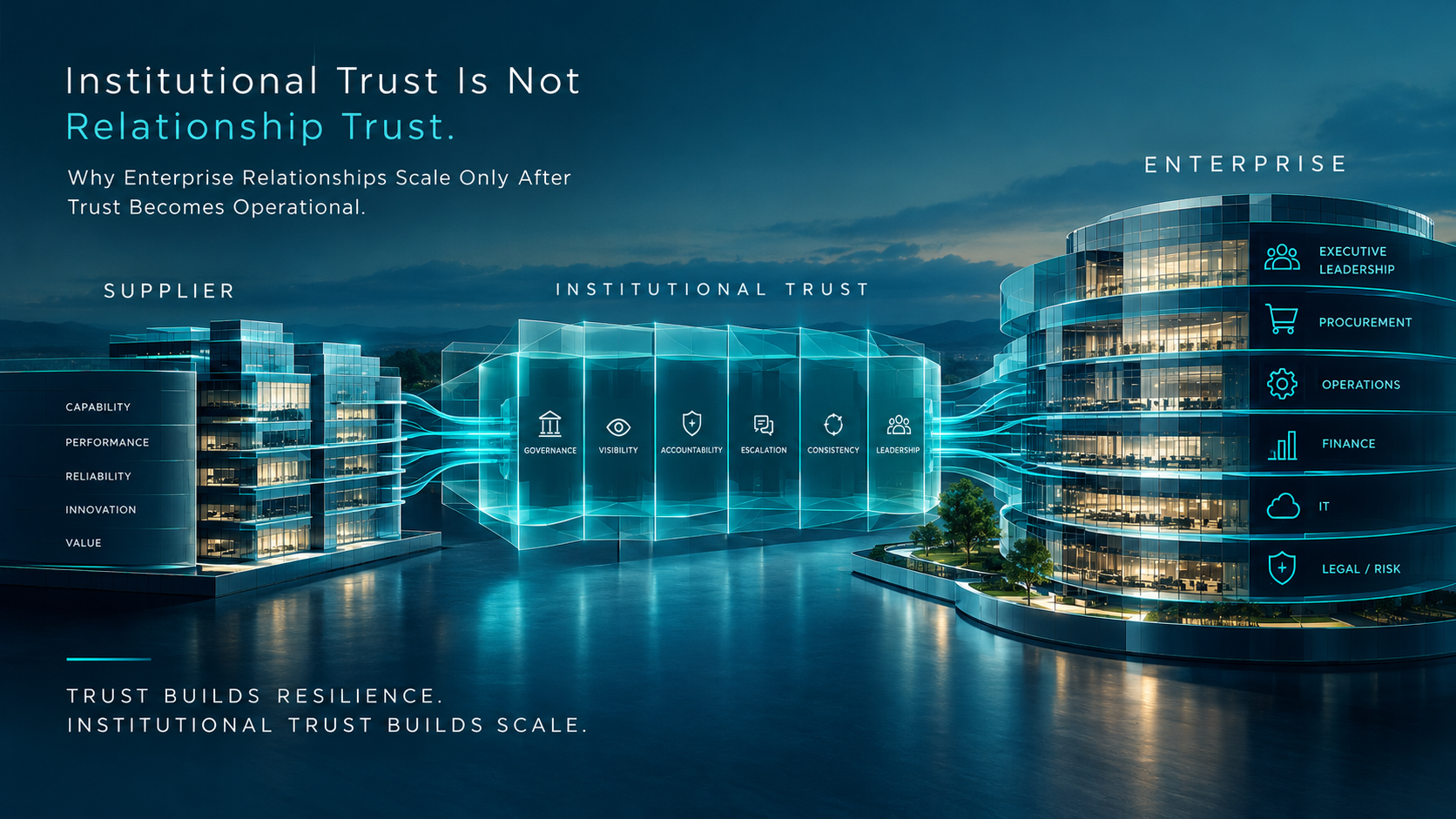
Why Enterprise Relationships Scale Only After Trust Becomes Operational
Most organizations misunderstand enterprise trust. They believe trust is built through relationships, responsiveness, familiarity, goodwill and personal credibility. These factors matter, but do not explain why some suppliers become enterprise dependencies while others remain replaceable.
Enterprise scaling requires a different form of trust, Institutional Trust.
Institutional Trust exists when confidence survives beyond individuals.
The Hidden Enterprise Reality
Many supplier relationships begin with strong personal trust.
An executive sponsor believes in the supplier.
A regional leader advocates for expansion.
An operational stakeholder champions the relationship.
Growth accelerates.
Nothing operational changed, what changed was the enterprise's willingness to institutionalize the relationship.
Then one of these individuals leaves.
• Expansion slows.
• Momentum disappears.
• Questions re-emerge.
The supplier discovers an uncomfortable truth, the enterprise trusted people. It never trusted the institution.
Relationship Trust vs Institutional Trust
Relationship Trust asks: Do I trust them?
Institutional Trust asks: Can the organization trust them?
The difference is profound.
Relationship trust is personal, institutional trust is systemic.
Relationship trust remains localized, institutional trust extends across regions, functions, and leadership transitions.
How Institutional Trust Forms
Institutional trust develops through repeatability.
Organizations begin to believe:
• Performance is predictable
• Governance remains consistent
• Escalation follows reliable pathways
• Commitments hold across functions and leadership changes.
• Disruption can be managed without destabilizing the relationship.
Over time, confidence compounds. Trust becomes less dependent on relationships and more dependent on demonstrated survivability.
The Executive Test
The simplest test for institutional trust is this: Would the relationship survive leadership change?
If the answer is uncertain, the relationship may depend more on individual sponsorship than on institutional confidence.
This is why enterprises place such importance on:
• Governance
• Visibility
• Executive engagement
• Issue ownership
• Operational consistency
These mechanisms create trust continuity.
Why Enterprise Expansion Accelerates
Institutional trust reduces organizational anxiety.
Stakeholders become more comfortable with:
• Increase in scope
• Introduce new regions
• Expand spend
• Integrate additional services
• Increase dependency
The enterprise no longer asks: Can they do this?
The enterprise begins to ask: How much more can they do?
This shift changes the trajectory of the relationship.
The Strategic Shift
Organizations often invest heavily in relationship development.
Enterprise-ready organizations invest in trust infrastructure.
They focus on:
• Governance continuity
• Escalation discipline
• Operational transparency
• Executive visibility
• Repeatable performance
The objective is not simply to build confidence. It is to make confidence durable.
Key Insight
Relationship trust opens the first door. Institutional trust keeps opening the next ones.
This is why Institutional Trust represents the third stage of Enterprise Readiness System™.