Most supplier strategies don’t fail loudly.
They fail slowly; through missed commitments, inconsistent execution, recurring disputes, stalled innovation, and value that never quite shows up on the balance sheet.
What makes this uncomfortable is that many organizations have done “everything right”, they have:
• Invested in AI and analytics
• Strengthened contracts
• Launched supplier relationship programs
• Increased review cadence
And yet outcomes remain fragile.
The issue is rarely effort or intent. It is architecture.
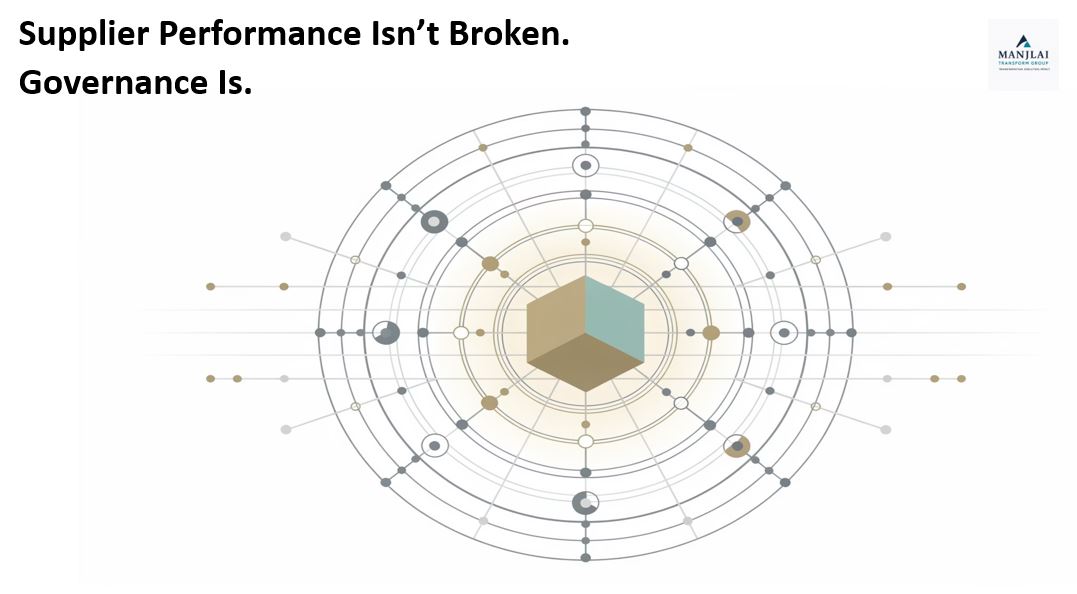
Governance is the operating system. AI is an application layer.
Until supplier governance is designed as infrastructure, not coordination then even the most advanced tools will underperform.
The AI Fallacy: Optimization ≠ Governance
AI has dramatically improved procurement’s ability to:
• Analyze patterns
• Optimize transactions
• Detect anomalies
• Accelerate decisions
What it cannot do is:
• Enforce accountability
• Clarify decision rights
• Resolve allocation disputes
• Create credible competition
• Build trust under pressure
AI optimizes within a system. If the system is fragmented,AI simply makes fragmentation faster.
Supplier excellence requires infrastructure. Infrastructure requires governance.
The Hidden Cost of Weak Governance
Weak supplier governance rarely shows up as a single failure.
It shows up as enterprise drag.
• Leaders spend time arbitrating issues that should never reach them
• High performers are treated the same as under-performers
• Suppliers optimize for relationships instead of results
• Innovation becomes episodic instead of repeatable
• Cash flow improvements appear in plans but not in reality
• Every disruption becomes a fire drill
These are not supplier problems. They are governance design problems which don’t resolve through effort, it resolves through structure.
Why Fragmented Engagement Destroys Accountability
In most organizations, supplier engagement evolved organically:
• Regional models developed independently
• Services and capabilities varied
• Standards drifted to accommodate local realities
• Escalations became reactive
Not all suppliers are global. Not all services are comparable. Regional nuance is real.
But when customization is unintentional, governance loses credibility.
The solution is not rigid uniformity. It is intentional consistency.
Supplier performance doesn’t break because suppliers are inconsistent.
It breaks because governance is.
Governance Architecture Is the Operating System
Effective supplier governance begins with architecture, not meetings.
At its core, that architecture includes:
• Centralized standards with flexible execution
• Clear decision rights - who owns performance,allocation, and disputes
• A fixed executive cadence that replaces ad hoc escalation culture
Where global standardization creates leverage, it must been forced. Where regional customization is required, it must be explicit not accidental.
When governance architecture is designed deliberately,accountability replaces ambiguity and behavior changes.
Strong governance gives operators time back because fewer issues reach them.
• Escalations decline.
• Fire drills reduce.
• Energy shifts from arbitration to advancement.
That shift alone is leverage.
Supplier Excellence Infrastructure: Designing the Environment
Most organizations believe they manage suppliers. In reality, they manage conversations.
Supplier excellence does not come from:
• Quarterly business reviews alone
• Relationship management without consequences
• Dashboards without governance
It comes from infrastructure.
You don’t manage suppliers. You design the environment they operate in.
That environment includes:
• Standard KPIs across suppliers and regions
• Transparent benchmarking and ranking
• Performance-linked business allocation
• Competition by design, not politics
When suppliers operate under the same:
• Metrics
• Cadence
• Executive expectations
Performance improves not because of persuasion, but because the system demands it.
Standardization in this context is not bureaucracy.
It is a:
• Power equalizer
• Credibility builder
• Scalability engine
At MTG, governance is not treated as oversight. It is designed as engineered leverage.
Executive Engagement Is the Force Multiplier
Governance systems do not sustain themselves. Leadership sustains them.
Supplier behavior changes when executive engagement is:
• Consistent
• Visible
• Structured
An effective engagement model includes:
• Single-threaded ownership
• Executive-to-executive forums, not only operational reviews
• Clear escalation paths with real decision authority
When leaders show up consistently:
• Standards stop drifting
• Data discussions mature
• Disputes resolve faster
• Accountability strengthens
Without executive engagement, governance becomes reporting. With it, governance becomes leverage.
Transparency as Reputation Protection
Transparency is often feared because it is misunderstood.
Suppliers will challenge data.
They will test assumptions.
They will push back.
That is not failure, it is part of credibility-building.
Effective transparency requires:
• Standardized context
• Collaborative data validation
• 360° feedback loops
• No surprises in executive forums
• No side conversations that undermine formal governance
Transparency doesn’t inflate feedback. It standardizes reputation.
• High performers are protected.
• Under-performance becomes clear and actionable.
• Trust grows because ambiguity disappears.
When Governance Matures, Value Emerges
The early stages of governance redesign are not glamorous:
• Heavy preparation
• Data reconciliation
• Executive alignment
• Iteration and adjustment
Results are not immediate.
Many organizations lose patience just as the system begins to work.
But as governance matures:
• Less time is spent policing performance
• More time is spent on strategic dialogue
• Innovation becomes structured and repeatable
• Cash flow discipline improves
• Crisis response becomes faster and more coordinated
Innovation and cash flow are not separate initiatives.
They are outcomes of governance maturity and will be explored further.
Why This Applies Across All Categories
The category changes.
The mechanics do not.
Whether in logistics, IT services, manufacturing, or indirect spend, the same principles apply:
• Architecture before optimization
• Infrastructure before innovation
• Discipline before value
Technology amplifies strong systems. It cannot compensate for weak ones.
The Real Shift
Supplier strategies do not fail because organizations lack tools, data, or intent.
They fail because governance was never designed to scale,endure, or compound.
Governance is not a meeting.
It is a system.
And systems, when deliberately designed, create leverage that compounds over time.
Organizations that engineer governance as infrastructure create environments where:
• Performance improves by design
• Accountability replaces ambiguity
• Trust strengthens under pressure
• Value emerges as a consequence and not a campaign
This is the shift.
From managing suppliers…
To designing the system they operate in.
That shift is what separates coordination from competitive advantage.